
When people talk about SEO, they usually mean the website. Page titles, speed, content, all of that. But a large part of how you get found happens outside your website entirely, and your Google Business Profile sits right at the centre of it.
That is off page SEO. It is the information about you that lives somewhere else, and Google reviews are one of the biggest pieces of it. They affect whether you appear at all, and they affect whether anyone bothers to call once you do.
Here are the seven things worth watching, and what to do about each one.
First, a question
Two businesses. Same service, same price. Which one would you call?
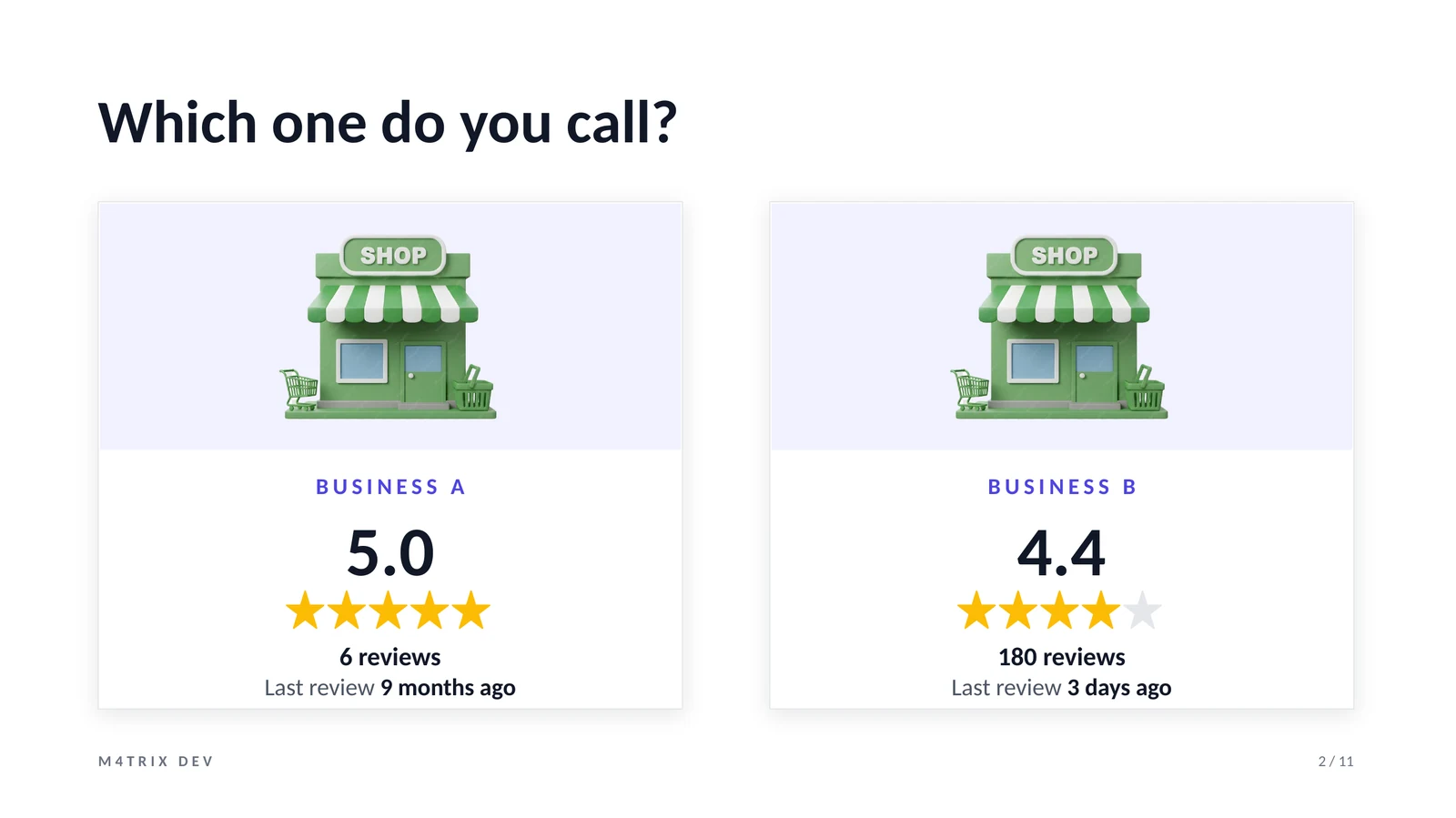
Business A has a perfect 5.0, from six reviews, and the last one landed nine months ago. Business B has 4.4, from a hundred and eighty reviews, and the last one landed three days ago.
When I ask a room this question, about 95 percent choose B, even though the score is lower. There is a good reason for that, and it comes down to three numbers.
Know your three numbers
Score
Below 4.2 and people start to hesitate. A clean 5.0 can also look suspicious, especially when the number of reviews is small.
Number
A handful of reviews could be family and friends, or simply luck. A large number becomes a pattern.
Velocity
How often new reviews land, and how recent the last one is. Regular arrivals matter more than most people realise.
It is tempting to look for a target number. The honest answer is that only the score has one. The other two depend entirely on your competitors.
It all depends on your competitors
Because the target moves depending on who you are up against, the useful exercise is to plot everyone on one chart. Number of reviews along the bottom, average rating up the side, every competitor marked.
The chart splits into four. Bottom left is low visibility, few reviews and a middling score. Bottom right is the awkward one, plenty of reviews but a rating that is dragging you down. Top left is the hidden champion, genuinely good and almost invisible, which is where a surprising number of decent businesses sit. Top right is the market leader corner: plenty of reviews and a score that holds up.
Most businesses have never seen this for themselves, and it is usually the moment the penny drops. It also answers the question everybody asks, which is how many reviews they actually need. The answer is however many the businesses above them have, and not one round number that applies to everyone.
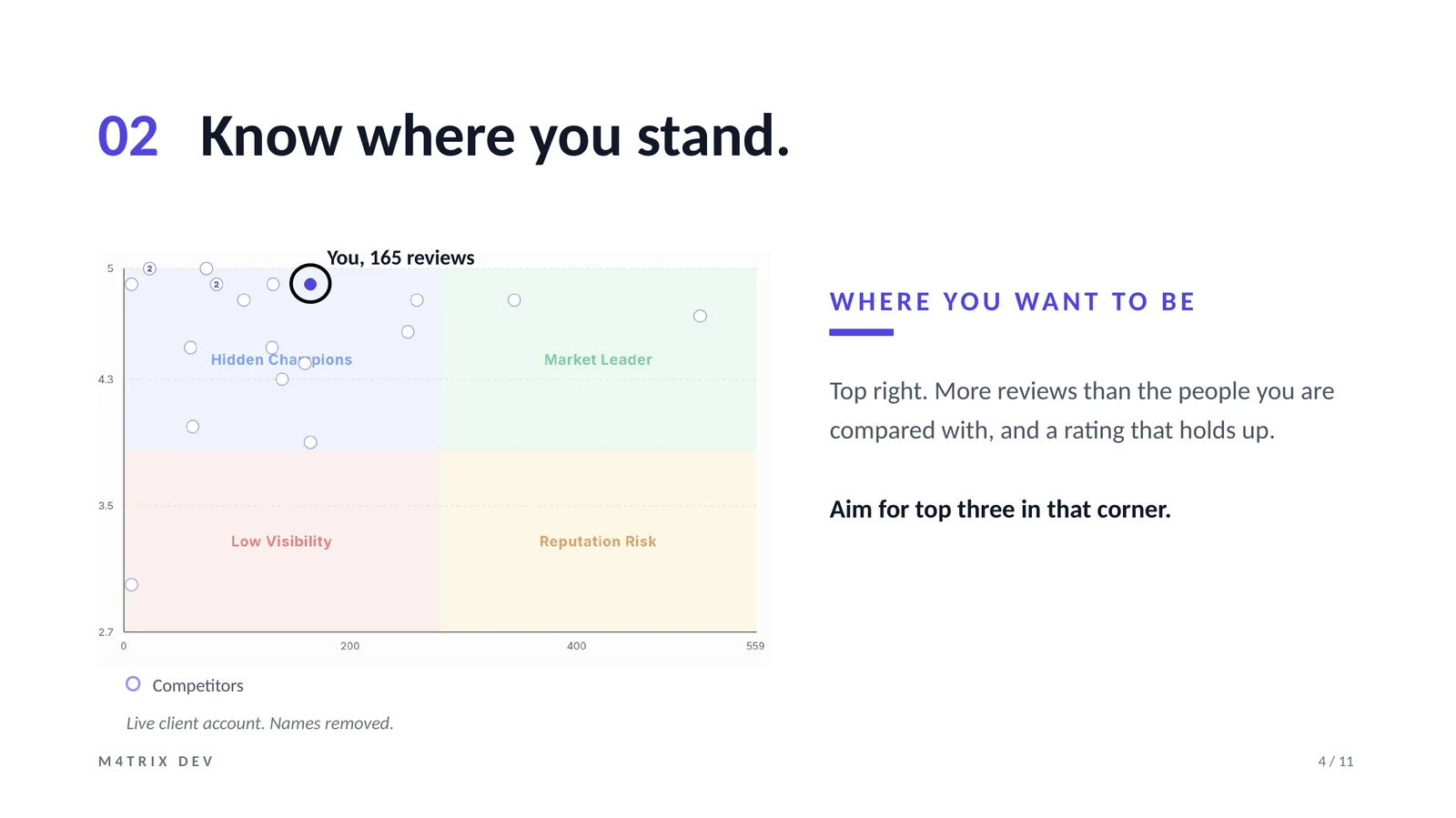
"Your numbers mean nothing on their own. They only mean something against the businesses you are compared with."
Take yourself out of the process
How do you move up the chart? By asking. And this is where most of us struggle, because we forget, or we remember three weeks later when it feels awkward to bring it up.
So take yourself out of the process. A request goes out automatically a day after the job is done, using whichever channel suits your customers, and anyone who has not clicked gets one reminder a few days later.
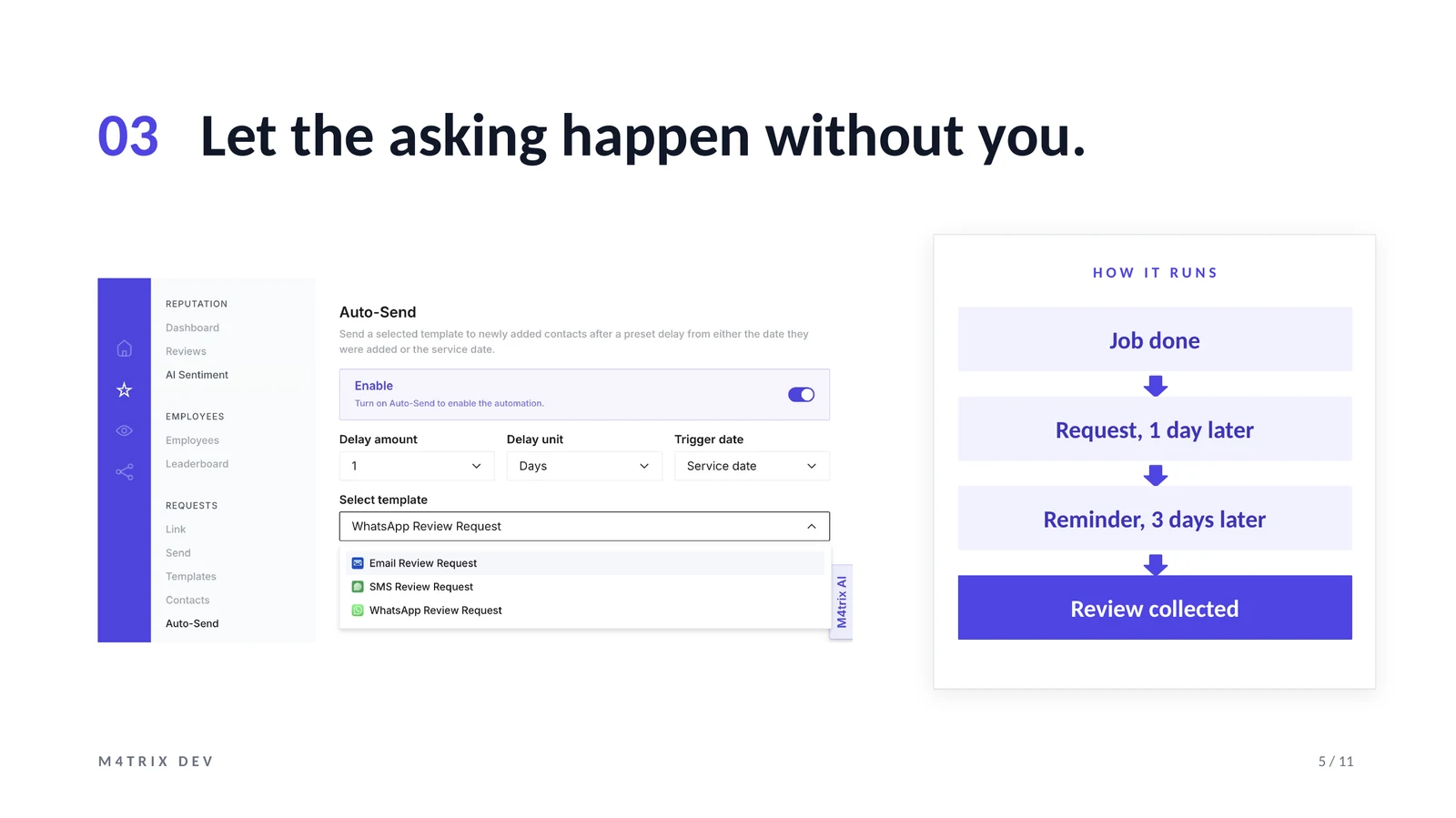
Email, SMS or WhatsApp. Once it is set up you do nothing, and it keeps running. That consistency is the whole point, and it is usually the difference between a handful of reviews a year and a steady stream every month.
Ask your best clients to say it on camera
This one is not technically a Google review, but it is every bit as useful. Thirty seconds of a happy client talking is the most persuasive thing you will ever put on your website.
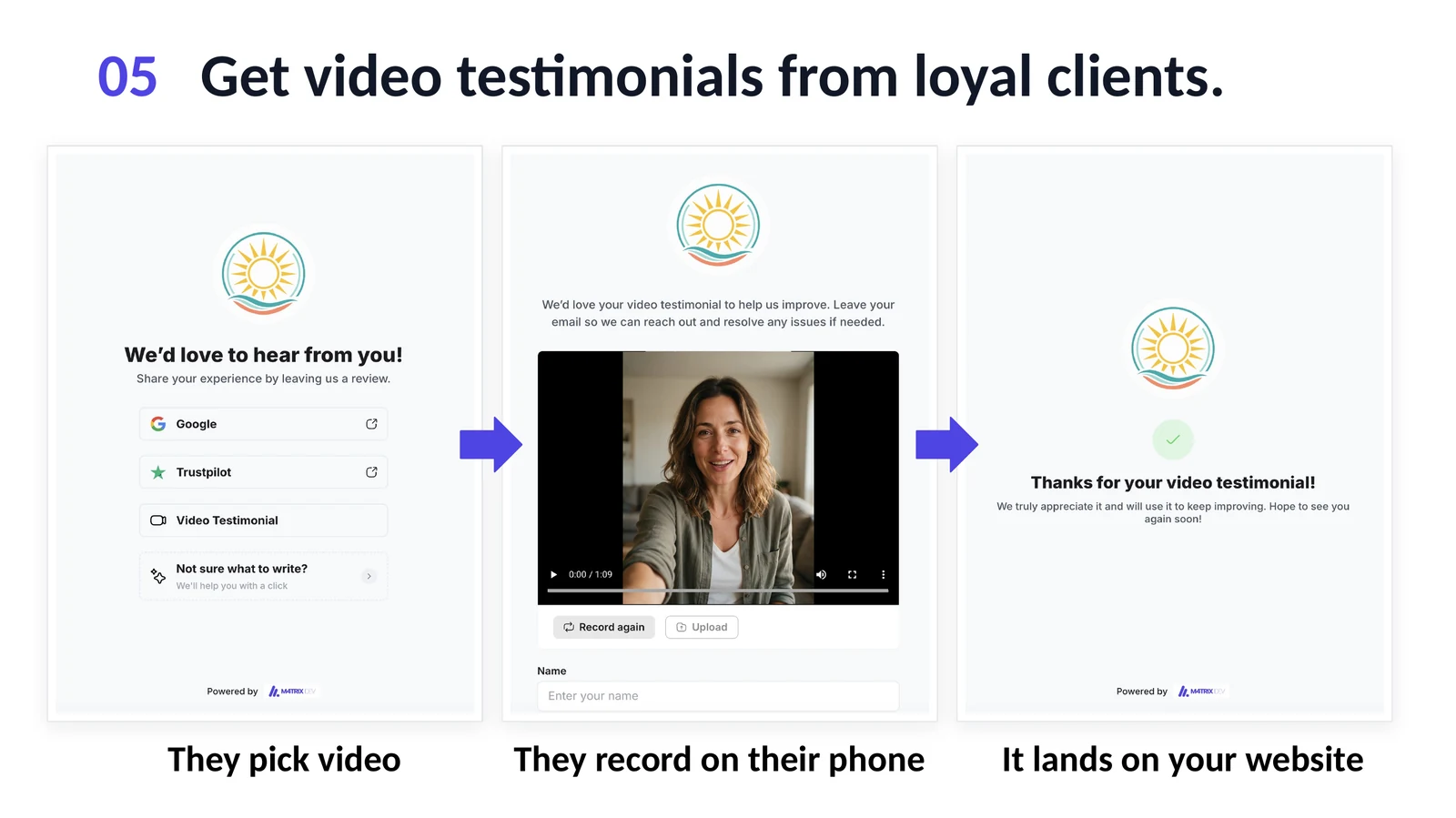
It works through the same link. The client lands on a simple page, taps video testimonial, records themselves there and then, and it appears on your site. No filming, no editing, nothing for you to do. The amount of proof it adds to a business is out of all proportion to the effort involved.
Google reviews are only half the job
Reviews on Google mostly help with visibility. Reviews on your own site help with conversion. They are two different jobs, and you want both.
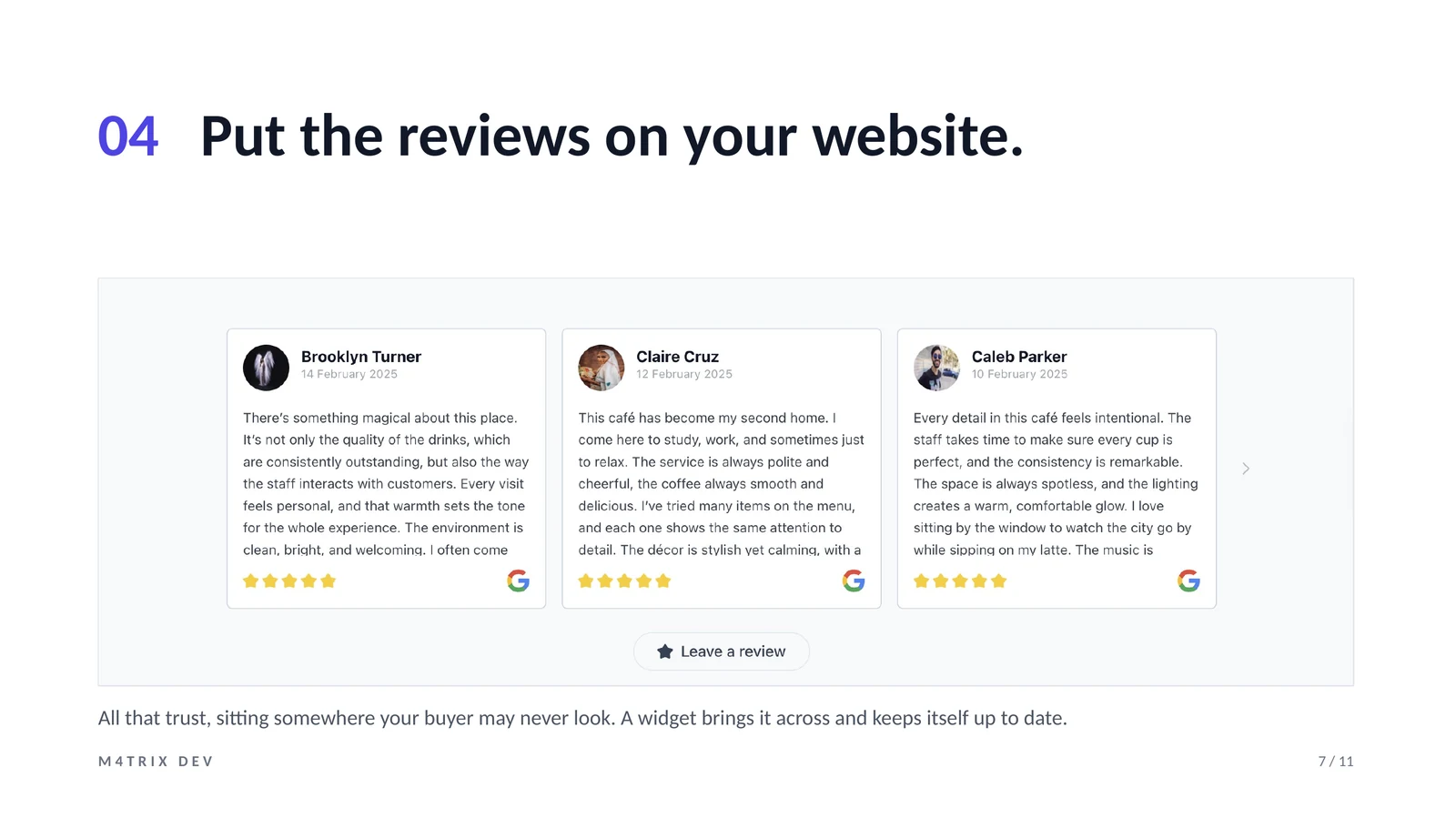
All that trust you have built sits on Google, while the person actually deciding whether to call you is on your website where they cannot see any of it. A widget brings them across and keeps itself up to date, so a new review on Google appears on your site without anyone touching it.
Do not just say thank you
Most people treat replies as good manners. They are also text on your profile that you control, and Google reads it.
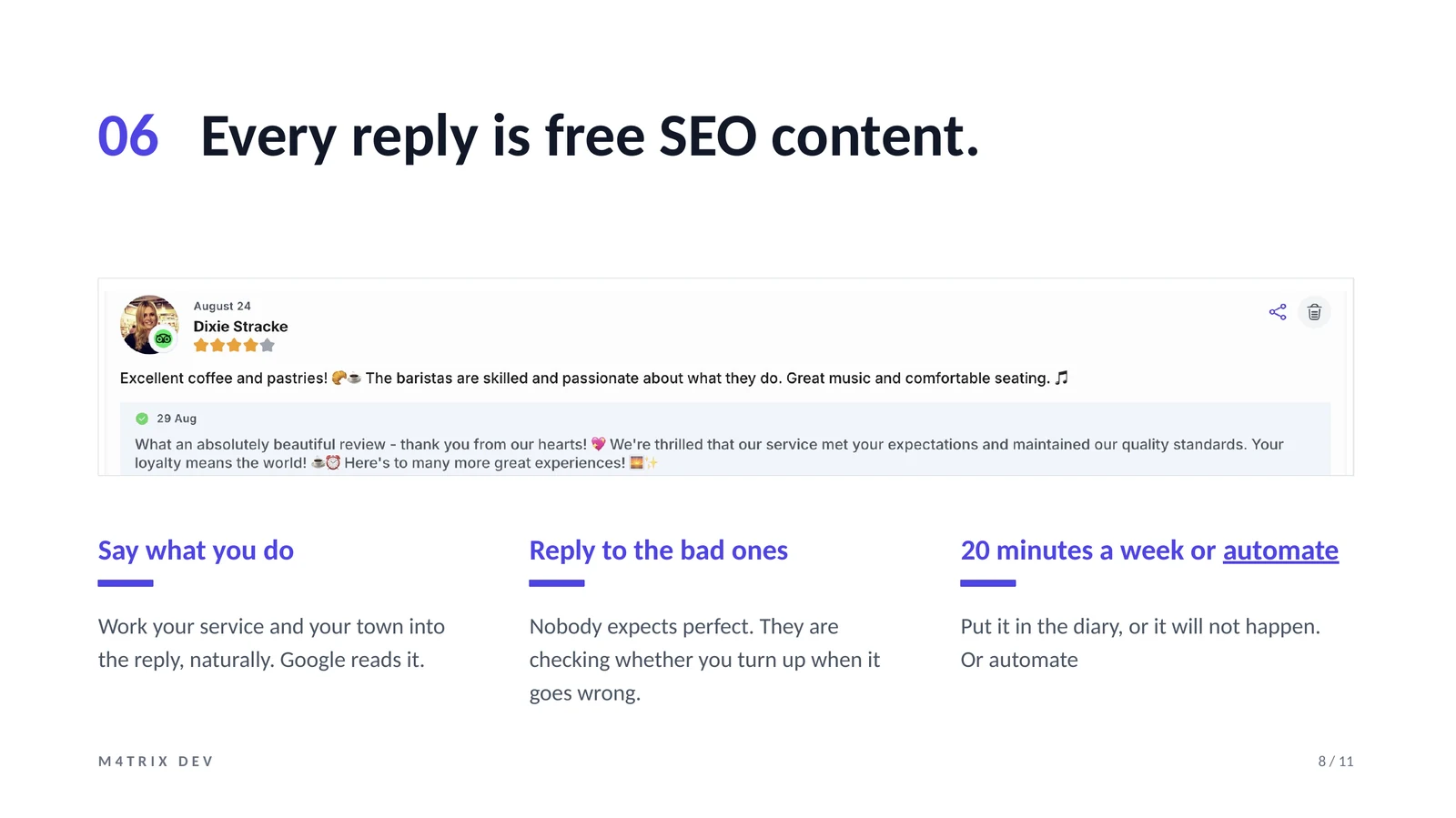
So do not just say thank you. Thank you is lovely and it does nothing for you. Work in the words you want to be found for, naturally: the service you provided and the town you provided it in. Then put twenty minutes in the diary each week, or automate the drafting so the replies still sound like you.
Reply to the bad ones too. Nobody expects a perfect record. What people are really reading is how you behave when something goes wrong.
The boring one nobody finishes
This is the boring one, and it is a long list. It is also free, which is exactly why almost nobody completes it. The more complete and current the information on your profile, the better that profile performs.
- NAP: name, address and phone identical everywhere
- Verification complete, for every location
- Primary category, then every secondary one
- Every service listed, each one described
- Description written for how people search
- Opening hours, plus bank holidays
- Service area, or the address if people visit you
- Phone, website and booking links, all tracked
- Logo and cover image
- Photos of premises, team and work, updated monthly
- Products, with prices
- Attributes: payments, accessibility, parking
- Questions and answers, seeded and kept current
- Google Posts, regularly, image and text
- Reviews answered, every one
- Mirrored to Bing Places and Apple Maps
- Directory listings, consistent on every one
- Schema markup on the site, matching the profile
- A local page on your site for every location
- Everything checked again after a Google update
Things to keep on top of. Most profiles manage about four of them, which is a sizeable missed opportunity for something that costs nothing.
What this looks like in practice
None of this is theory. It is the work I do, and the pattern is consistent once the asking becomes automatic.
That last one is worth a mention. A London Business Improvement District bought the service on behalf of its two hundred members, and twenty of those businesses are being onboarded at the moment. If you run a group, an association or a membership body, this scales in a way that individual accounts do not.
Want to see where you actually sit?
Book twenty minutes and I will build your competitor map live, then walk you through where the opportunities are. It is free, and it is yours to keep whether we work together afterwards or not.
Book your free competitor mapIf you decide you want the work done rather than done yourself, the standard package is £597 for three months and covers the strategy and the execution. Either way, email hi@m4trixdev.com and I am happy to take a look at your profile.